Artificial intelligence (AI) is no longer a vision of the future - it is a strategic necessity. But how well prepared are companies really for the integration of AI? The study "On the road to AI excellence" by CorpIn GmbH from 2025 provides well-founded answers. Based on extensive company surveys, it sheds light on the digital maturity level of various industries and shows which factors promote or hinder the successful use of AI. The targeted use of AI is particularly relevant for areas such as human resources, where large amounts of data are processed and strategic decisions are made.
AI readiness: measured on six dimensions
At the heart of the study is the hexagon model, which assesses companies' readiness for AI along six dimensions:
- Data foundation
- Technical requirements
- Strategic objective
- Security & Privacy
- Cultural dimension
- Awareness & competence
The model makes it clear that the success of AI projects does not depend on technology alone. Data quality, culture and expertise are just as important. The six dimensions are examined in more detail below.
Data foundation: the basis for digital HR processes
A robust database is essential for AI applications to function at all and achieve their full potential. However, according to the study, only 8% of companies have fully consistent data structures. Over a third of the companies surveyed are still struggling with isolated data silos - a serious obstacle to automation and data-based decisions. Areas such as human resources, which depend on reliable employee data, therefore benefit from structured data storage.
Technical requirements: Specialized systems are lagging behind
A flexible IT infrastructure in central systems such as ERP, CRM and HR creates the necessary basis for successful AI integration. Specialized applications such as business intelligence (BI) and supply chain management (SCM), on the other hand, often have compatibility issues that can make seamless integration difficult. These system discontinuities prevent the consistent use of data-driven processes - including in HR, for example in personnel analyses.
Integrated HR systems such as the Umantis HR-Suite provide a remedy here: with standardized workflows, interfaces and a clear data structure, they form the basis for strategically embedding AI projects - for example through the targeted analysis of development processes or training requirements.
Strategic objective: lots of potential, but little anchoring
65% of the companies surveyed see AI as part of their long-term strategy - but only 26% have actually anchored it centrally. Clear goals and KPIs are rare, which makes the success of AI initiatives difficult to measure and can hinder the expansion of AI use.
Security & privacy: minimum standards yes - certifications rare
Only 20% of companies comply with ISO/IEC 27001 standards . While many adhere to GDPR/DSG requirements, comprehensive security concepts are rare – particularly critical for AI projects involving sensitive employee data. For HR departments, this is a clear signal to structurally strengthen security and compliance . The cloud-based Umantis HR-Suite supports this with GDPR-compliant data storage , role-based access , and verifiable audit functions – key requirements for trustworthy AI applications.
Cultural dimension: between openness and uncertainty
According to the study, the majority of employees have an open attitude towards AI : 39% of companies are in favor of using AI, 47% have a mixed picture. Only 3% perceive pronounced skepticism. Nevertheless, clearly structured and regular feedback is crucial in order to reduce uncertainty and support learning processes in a targeted manner. Particularly in highly routine fields of work such as data processing or document management, the use of AI not only offers efficiency gains, but also noticeably relieves employees of monotonous tasks - which has a positive effect on their satisfaction. Whether new technologies can be accepted in the long term and their full potential exploited ultimately depends heavily on conscious cultural changes and targeted transformation measures.
Awareness and skills: Still plenty of room for improvement
51% of companies do not offer regular AI training. Only 9% rely on mandatory, comprehensive further training. Although basic knowledge is taught, strategic and technical aspects are often neglected. In addition, many companies struggle with a lack of specialist knowledge - whether internal or external. 39% of companies do not have an AI specialist in the company.
Conclusion: AI needs structure, strategy and training
The study clearly shows that many companies want to use AI - but the structural, technical and cultural requirements are often still lacking. For HR, this means that if you want to digitalize processes, make data-based decisions and develop employees in a targeted manner, you need to invest in data quality, system integration, training and IT security.
Systems such as the cloud-based Umantis HR-Suite provide a sustainable infrastructure to:
- Structure data better
- Standardize processes
- Develop skills in a targeted manner
- Ensure data protection and security
- and gradually integrate AI applications into everyday working life
A look at the Umantis results in the benchmark
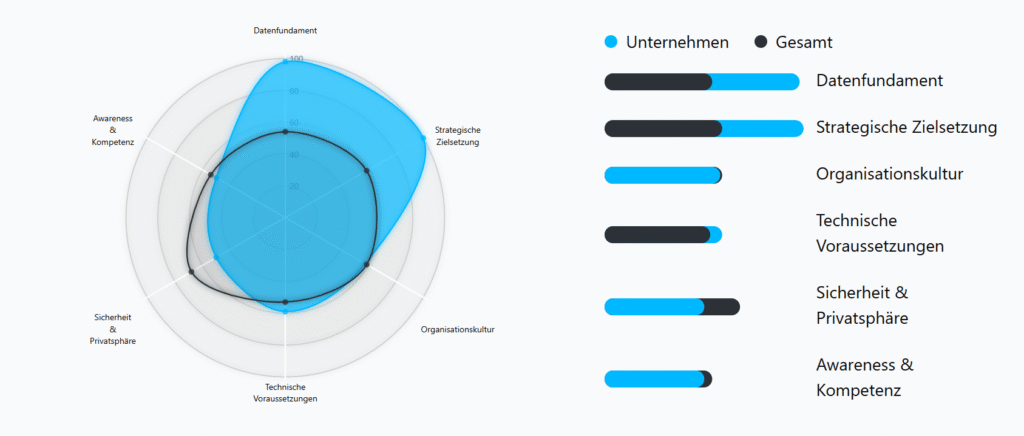
Abacus Umantis also took part in the AI maturity analysis. With an overall score of 65/100 points, the company is well above the Swiss average. It scored particularly highly:
- Data foundation (98/100 points)
- Strategic objective (100/100 points)
These results show a clearly defined AI strategy and a high level of data maturity - two decisive success factors for future-oriented HR digitalization.
Those who set the course for AI integration today will secure a real head start tomorrow - in terms of efficiency, transparency and innovative capacity.